subjectivity of memory
A Moveable FeastIn Ernest Hemingway’s memoir, the subjectivity of memory is not simply a warning that recollections may be inaccurate; it is a condition the narrative makes visible as people retell, revise, and fail to share the same past. F. Scott Fitzgerald’s changing accounts of Zelda Fitzgerald and a French naval aviator sit beside Hemingway’s vivid but unresolved reconstruction of the episode, while a later demand for absolute truth exposes how recollection can become emotionally dangerous. At the book’s close, the same principle widens into a claim about Paris: a place persists, but no two people remember it in the same way.
Stories Revised in the Telling
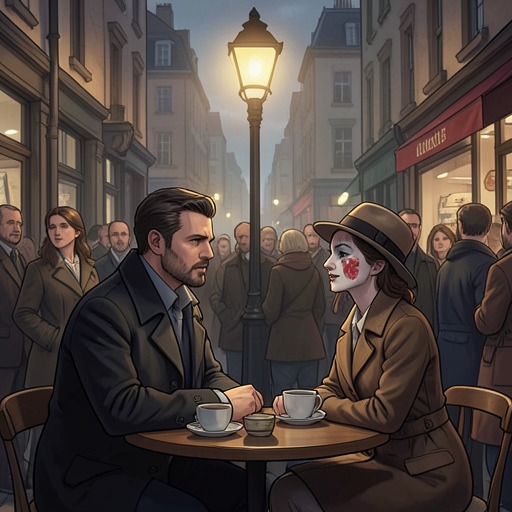
One night, during the first separation from Zelda Fitzgerald since their marriage, F. Scott Fitzgerald drank several whisky sours and began recounting their life together. Among the events he described was something tragic that had happened at Saint-Raphaël about a year earlier: Zelda had fallen in love with a French naval aviator. Hemingway distinguishes this first telling from the versions that followed. Fitzgerald later recounted the episode differently, as though testing possibilities for a novel. The later versions were better told each time, but none affected Hemingway as deeply as the first.
That distinction makes the scene more than a report of competing stories. Hemingway says he believed the first version, yet allows that any of them might have been true. His confidence in its emotional force does not settle its factual status. Indeed, the successive tellings improve as stories while becoming less decisive as evidence: narrative craft can sharpen an account without making its underlying truth more certain. The memoir preserves the versions’ differences rather than choosing one and erasing the rest.
The Vivid Scene and the Unanswered Question
Fitzgerald wanted Hemingway to understand what had happened at Saint-Raphaël. As he listened, Hemingway could picture the single-seat seaplane buzzing the diving raft, the sea’s color, the pontoons and their shadow, the two tans, the contrasting shades of blond hair, and the aviator’s darkly tanned face. The precision of this image makes the scene feel witnessed, although Hemingway is reconstructing it from Fitzgerald’s account rather than claiming to have been there.
That vividness brings an uncertainty into sharper focus rather than resolving it. Hemingway cannot ask how the aviator story, if true, could coexist with Fitzgerald sleeping in the same bed as Zelda each night. He considers whether that contradiction made the story sadder, or whether Fitzgerald might not remember, as he had failed to remember the previous night. The account therefore holds an intimate detail and an unanswered question together. Sensory clarity is not proof of complete knowledge: the scene becomes imaginable, but its contradictions remain.
The Cost of Absolute Truth
Much later, after Zelda Fitzgerald’s First Mental Breakdown, Fitzgerald asked Hemingway to lunch at Michaud’s in Paris. He said he had something of great importance to ask and required an absolutely truthful answer. Hemingway knew the pattern such requests could set in motion: a candid response might make Fitzgerald angry, sometimes only after he had brooded over it, until Hemingway’s words became something to destroy—and, if possible, Hemingway himself. Truth here is not an uncomplicated virtue. It enters a relationship where remembered or spoken words can acquire a force beyond the moment in which they were offered.
The lunch’s measured circumstances contrast with that emotional risk. Fitzgerald drank wine without being affected by it and had not prepared by drinking beforehand. They talked about work and other people; Hemingway knew Fitzgerald was writing something good and having difficulty with it, but that was not the subject he had come to raise. He waited through the meal until the cherry tart and final carafe of wine, when Fitzgerald declared that he had never slept with anyone except Zelda. Placed beside the earlier account of the aviator and Hemingway’s lingering question about the couple’s nights together, the declaration does not neatly close the discrepancy. Instead, the memoir lets the earlier story, the later assertion, and Hemingway’s uncertainty remain in tension.
Recollection, Absence, and Paris
A brief exchange about the dead gives memory another limit. Georges says it is strange that he has no memory of a particular man. Hemingway replies that all those people are dead; Georges insists that people are not forgotten merely because they have died, noting that others keep asking him about the man and asking Hemingway to tell him something for his memoirs. The exchange makes recollection both personal and social: one person’s absence of memory does not prevent other people from preserving, requesting, or transmitting an account. A memoir may carry forward what its subject cannot recall, but it cannot make every recollection shared.
The book’s final reflection generalizes this unevenness without pretending to overcome it. The memory of each person who has lived in Paris differs from everyone else’s, even as people return to the city under changed circumstances and with different degrees of difficulty or ease. Paris remains recognizably itself, but the people who revisit it have changed, and their histories shape what it gives back. Hemingway presents his own account of the early days, when he and Hadley Richardson were poor and happy, as one situated memory rather than a universal version of the city. The book thus ends not by correcting the past into a single authoritative narrative, but by affirming that return, like recollection, is always particular.